‘An act of decency’
Shul’s Veterans Day program is about properly marking Jewish veterans’ graves in Europe
During the chazzan’s repetition of the Amidah, the congregation generally answers amen to each blessing, Shalom Lamm said.
Mr. Lamm is the chief historian and co-founder of Operation Benjamin, an organization that identifies Jewish American soldiers who were buried in United States military cemeteries under Latin crosses and facilitates replacing those headstones with Stars of David.
“There’s only one blessing for which that does not work, and that’s Modim” — a blessing of thanks — Mr. Lamm continued. For that blessing, the chazzan’s rendition is not sufficient — “we are required to say Modim ourselves because gratitude cannot be expressed through a shaliach” — a messenger.
Teaneck’s Congregation Rinat Yisrael will host a program on Shabbat morning, November 8, after services, in observance of Veterans Day. The impetus for the event is Operation Benjamin’s work, Kenny Hoffman of Teaneck, a Rinat member who is co-chairing the program, said. Mr. Hoffman conceived the idea of marking Veterans Day in shul and created the program two years ago, after going to France with Project Benjamin to witness the ceremonies at United States military cemeteries where grave markers were changed.
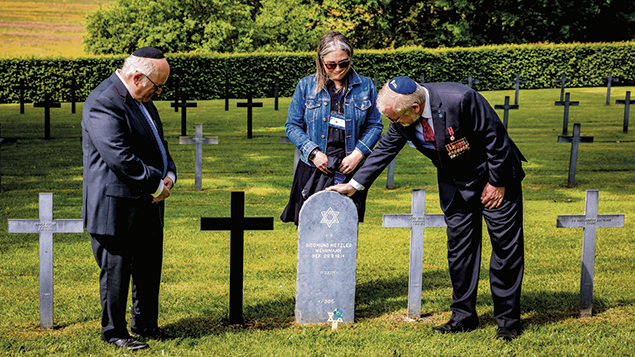
Mr. Hoffman found the ceremonies inspiring.
“These are people who made the ultimate sacrifice for the United States and for democracy, and they should be honored appropriately and buried in accordance with their religion,” he said. He felt it was important to start a program at Rinat to recognize and show appreciation to people who have served or now are serving in the United States armed forces.
The goal of the program is “to raise awareness that Jews were very involved in participating in the military and to honor those who fought for freedom and for democracy,” he said. “It’s never too late to pay respect to those who have given so much to their country.”
Rinat has invited two nearby shuls, Congregations Beth Sholom and Bnai Yeshurun, to join the event. (Bnai Yeshurun, like Rinat, is modern Orthodox; Beth Sholom is Conservative.)
In conjunction with the program, Mr. Hoffman and Rabbi Jacob J. Schacter, another Rinat member who is co-chairing it and is Operation Benjamin’s president emeritus and diplomatic liaison, invited congregants to submit pictures and short bios of family members who served or now serve in the U.S. armed forces. The first year Rinat held the program, about 100 listings were compiled into a booklet and distributed there, Mr. Hoffman said. Last year’s handout highlighted the service of approximately 175 congregants and family members, and he hopes to see that number increase as more people learn about the program.
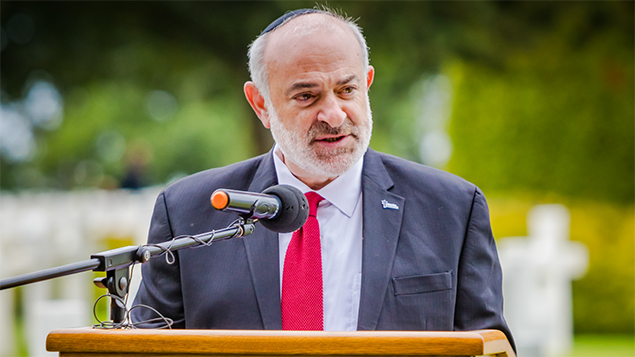
Some of those highlighted “held pretty senior positions in the military,” Mr. Hoffman added. “They’ve given, in some cases, their professional careers. Others gave their time and their service to the United States. They should be recognized and appreciated for that.”
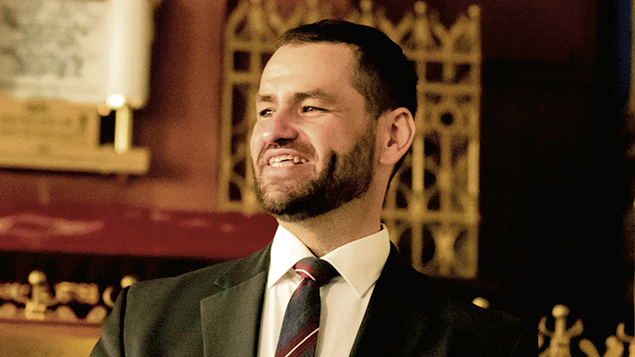
General Dirk Backen, secretary general of the German War Graves Commission, will be the guest speaker at the ceremony. Rabbi Zsolt Balla, the German Army’s first Jewish chaplain in 90 years, will join the congregation for Shabbat.
General Backen served in the German military for almost 40 years, where he held several positions including platoon and company commander. He was the defense attaché at the German embassy in Washington, D.C., during his last four years in the military; he retired in 2017. In 2019, he joined the German War Graves Commission as director of service and cooperation and became the commission’s secretary general in 2021. General Backen has received several national and international military and non-military decorations, including NATO’s Meritorious Service Medal and the U.S. Legion of Merit (officer class).
A couple of years ago, in cooperation with Operation Benjamin, General Backen launched Operation Levi to identify Jewish German World War I soldiers who were buried in German military cemeteries under Latin crosses and facilitate replacing those headstones. He sees Germany’s changing of the grave markers as more than a way to rectify a past mistake. “I personally believe it is like a contribution to reconciliation,” he said. “Reconciliation does not forgive the deeds of the past. It liberates the future.”
Earlier this year, Operation Levi replaced five headstones at ceremonies that included family members. “It was so moving to see what you can do with a pretty simple gesture,” General Backen said. “You just change a headstone, but it means so much. It is a matter of decency, because we owe this to these soldiers. It is also something that I believe is a strong statement against the rising antisemitism in Europe and all over the world.
“There’s not much we can do to make the events of the past unhappen,” he continued. “That is not possible. It all happened, and we know the history, and from that there derives a special responsibility, but this is something, this is one of the few small things where you can actively repair something.
“You cannot bring back someone to life who was killed in the Holocaust. You cannot comfort families who lost family members in the Holocaust. It’s not possible. But what you can do is that little kind of repair, that little acknowledgement of the Jewish identity that was part of German culture in those days, and stress this and underline that this is important for us.
“Many things are done passively. You can go to Auschwitz. You can visit the former concentration camps. But this is an area where you can actively change something for the better. You can actively do something to give these soldiers back their religious identity. That is an act of decency.”
Maintaining soldiers’ graves is a “cultural achievement that is fairly new,” General Backen said. “In the past, nations did not do this; there were just mass graves after large battles where soldiers were buried. Individual recognition of the human being who is buried in a grave is something very, very precious that should remind us how precious life is.”
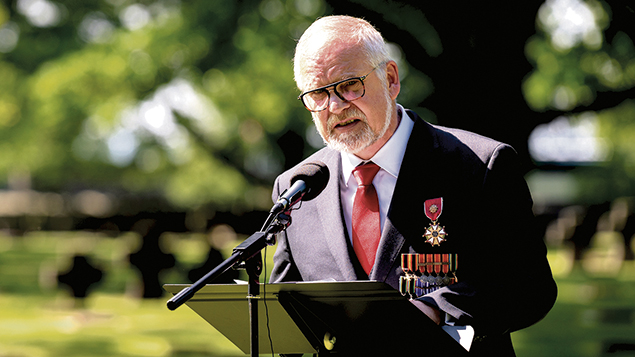
He also sees the solemn grave marker replacement ceremonies as playing a dual role. After a group of German soldiers attended one of the ceremonies, a high-ranking officer “came to me and said, ‘This was probably one of the most moving ceremonies I have ever attended in my life,’” General Backen said. “When people leave the cemetery, they not only take away the information — that this was a German Jewish soldier, and he was wrongly buried under a Latin cross. They take away an emotion. Information can fade away, but emotions stay.
“It’s always a moment that brings us together — people from different countries of this world who in the past waged war against each other. This is a work for a future peace, a reminder not to repeat the mistakes of the past, and that we have an obligation, especially toward future generations, to maintain this peace.
“If there is a heritage from these graves, if these soldiers are looking down on us from heaven, they probably would be pleased to see that their deaths were not meaningless, that there is something that came out of their graves as a good thing, something that brings people from different nations together to understand the human cost of war.”
Rabbi Balla has similar feelings about Operation Levi’s work. “The Jewish people has a very troubled past with Germany,” he said. “We have to learn from history” to work together.
And he is honored to participate in Rinat’s program. “Very often Jewish communities are isolated,” Rabbi Balla said. So he sees programs like this, which join communities, as important.
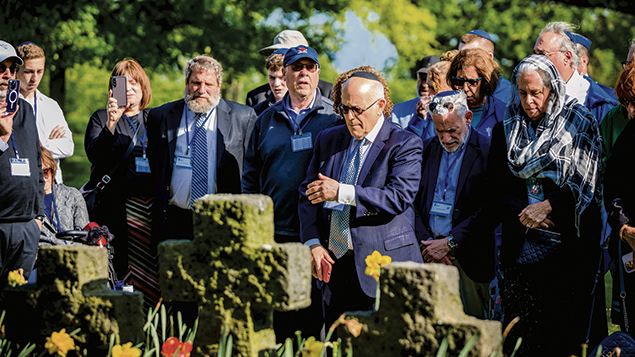
Mr. Lamm is not surprised that Rinat’s program was inspired by an Operation Benjamin trip. “We frequently hear from participants that they never had a connection to the military and never imagined that this would have such a profound impact on them, and it did,” he said. “And I will tell you that that’s natural, that once you’ve been there, once you’ve seen the dignity, the nobility, the poignancy, it just grabs you by the soul. And it did here.”
The ceremonies are “just so moving,” Mr. Lamm added. People who have been to one often return for others. “I’ve run every single one, and I can tell you, I never am there without saying to myself, ‘I cannot believe we’re here doing this. This is so profound.’”
He finds it gratifying that the Rinat program has become more successful each year. “You scratch the surface just enough, and you find that people have these amazing stories, and they have certainly scratched that surface. And people do have wonderful stories and relatives who served and who they’re very, very proud of.
“We very often take freedom for granted,” Mr. Lamm concluded. “America, with all its issues — and the issues are deep and compelling and troubling — is still that city on the hill. It is still the freest place, outside of Israel, that you can be as a Jew. Just look around the world and it’s very, very troubling. We tend, because we live our daily lives, to take things for granted, and we forget that people sacrificed years of their lives to fight in the military, to be part of that military, and many people sacrificed their lives, to ensure that freedom.
“That gratitude, I think, is the message of this event. It’s our chance, once a year, to acknowledge people’s service, and to acknowledge sacrifice. It is incumbent upon us as Jews to have and show that gratitude.”